An Instagram feed on your website means social proof in seconds – of course, if your page looks good there and shows real people actually interacting with your brand.
It’s a quick way to add fresh, real content to your website without overthinking it. Instead of another static section, visitors see recent photos, videos, and activity that make the site feel active and trustworthy.
But with the not-so-user-friendly Meta interfaces for getting API keys and embedding something, this seemingly simple task can become a challenge. So, let’s discuss some helpful tools, mostly for B2C businesses that want to turn Instagram activity into on-site trust, engagement, and conversions without killing its performance.
Instagram Feed as an Instant Social Proof Tool
According to Mark Zuckerberg, Instagram’s monthly active users (MAU) exceeded 3 billion at the end of 2024, up from 2 billion in 2022.
Impressive, considering that it was bought for just one billion back in 2012 – a fraction of the price that Meta paid later, for example, 2.3 B for Oculus VR or an impressive 19 B for WhatsApp.
But Instagram has long gone beyond just a social network. Instead, it has become a tool that helps businesses make money, especially those promoting visual or emotional products.
I could sit and dust off my ancient brain cells, remembering a time when blogs were cooler than Instagram, just a twinkle in Zuckerberg’s eye. And just like that, everything changed faster than I could blink. WordPress and the rest of the tech world had to catch up. Today, websites are basically Instagram’s backstage in so many cases, showing structured data, running sales, and keeping you in the driver’s seat.
So, now, nearly 40% of the world’s population is active there each month. This isn’t about trends but about reach.
When visitors see real user content, especially UGC (user‑generated content) from your Instagram, they trust the brand more. Multiple UX studies find that showing real people’s posts alongside product listings can increase add‑to‑cart actions and conversions more than traditional static product galleries.
Best Practices of Using Instagram Feed
Before we move on to adding Instagram to the website, let’s look at how some companies use it.
Instagram feed for community validation
For example, the company’s chill, niche, and elegant communication about a wide range of products for horse riders. It’s quite a compact community, and being featured there means something:
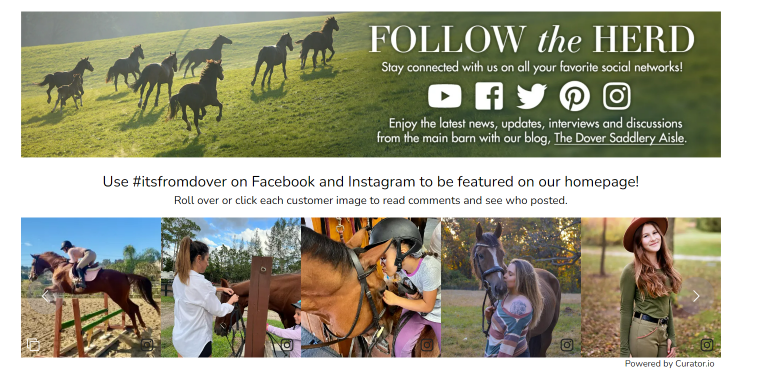
Here, users see a carousel of photos they can scroll through, open, and read comments on. In addition, the website owner shares user photos showing people’s emotions about riding horses. A potential client could immediately see themselves as a rider.
This approach to adding content increases the brand’s trustworthiness with minimal effort on the company’s part.
Instagram feed for use-case discovery
The next example is a static feed on a website.
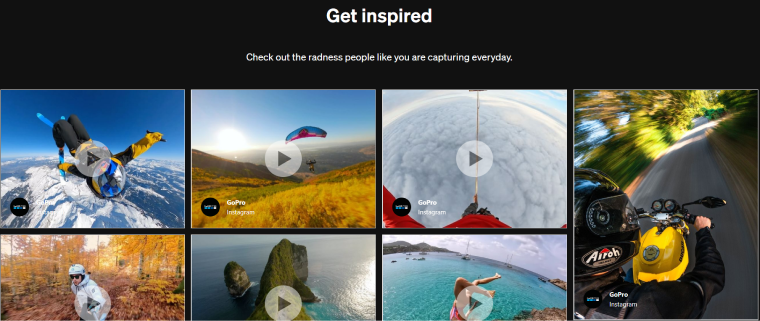
Here, users see different options for using a GoPro camera and learn whether this product is suitable for them and how to use it.
Instagram feed for aspirational positioning
Here is another example of using an Instagram feed not only to show use cases but also to connect with existing and potential customers through relatable posts.

In practice, you can add an Instagram feed either dynamically or as a static block. Which approach works best depends on your website’s design and goals, but the value is obvious. You can show full posts with captions or just images, and many plugins also support hashtag-based feeds or posts where users tag your business.
How to Add an Instagram Feed to the Website
Now we have come to the most interesting part. How to add an Instagram feed to the website and use all its advantages?
There are only two ways:
- Using the code, you can embed individual posts. Works well if you want to show some particular, very important, and cool posts. But if there are too many of them, it wouldn’t be good for page performance, because each one sends a request and tries to fetch not only the content but also the scripts.
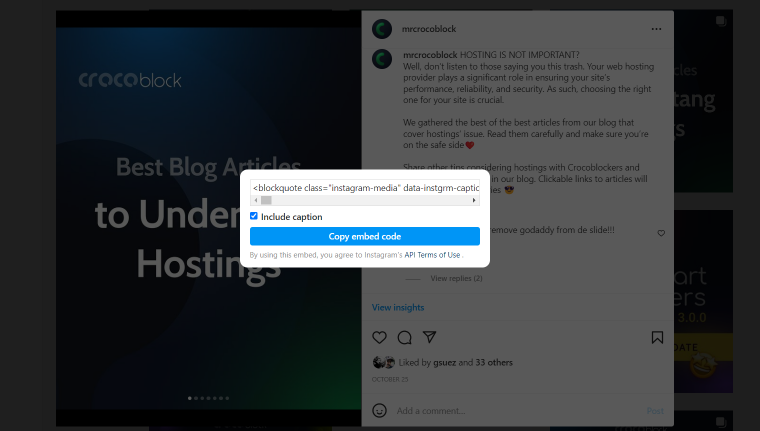
- Using plugins. Plugins also make it possible to style the Instagram feed, place it in the right place, and customize it as you need.
But any plugin needs a token, and obtaining it in the new Meta’s Tools for Creators interface has become a bit more challenging than before.
So, the video below will guide you through this process and how to embed a feed with a plugin:
4 Best WordPress Instagram Feed Plugins
So, you already have an Instagram page and a WordPress website. What’s next? Choose the plugin. Here are several popular plugins that help you add an Instagram feed, posts with specific hashtags, or shoppable posts to your website.
JetElements Instagram Widget (Premium)
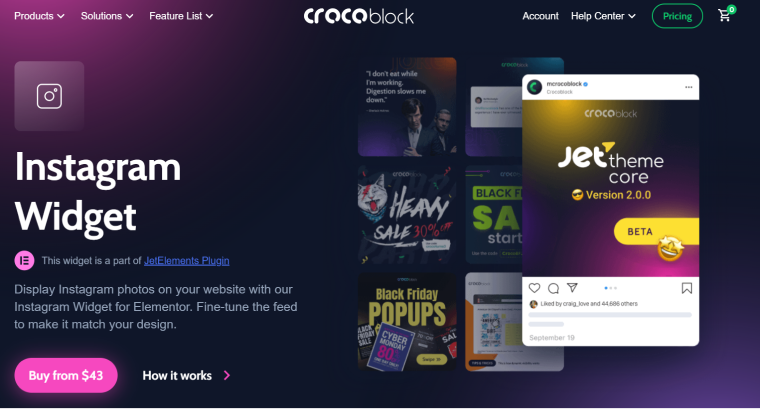
JetElements by Crocoblock helps you add the most daring design ideas to your WordPress website. Widgets, visualizations, and pop-ups – everything you can think of. A dedicated widget helps to add an Instagram feed and is easy to customize. Despite the plugin’s versatility, it does not slow down page loading.
Pricing: $43 a year (includes 39 different widgets for Elementor).
Spotlight (Freemium)
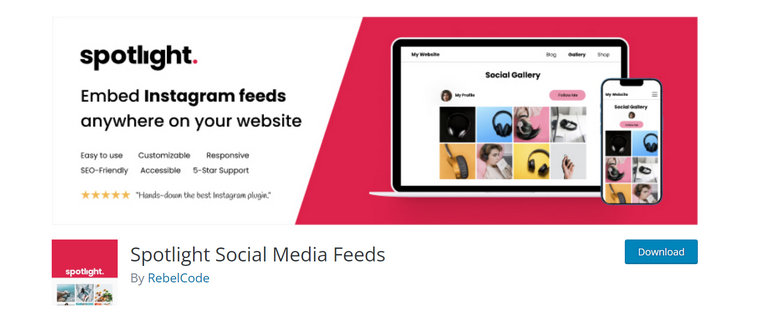
Spotlight plugin makes it possible to add an Instagram feed to the website in just a few clicks. With it, you can add multiple feeds to the WordPress site and customize the display for each device. In addition, you can control the display of the feed from the toolbar.
Pricing: free; Premium starts at $59 a year.
Feed Them Social (Freemium)
Feed Them Social is a plugin designed to add feeds from various social networks to the website: Instagram, Facebook, TikTok, and YouTube. The paid version can even add a button asking users to subscribe to your social networks, which is very convenient for expanding your audience. The feed of any selected social network is added to the website using shortcodes.
Pricing: free; Premium starts at $40.
Social Feed Gallery (Freemium)
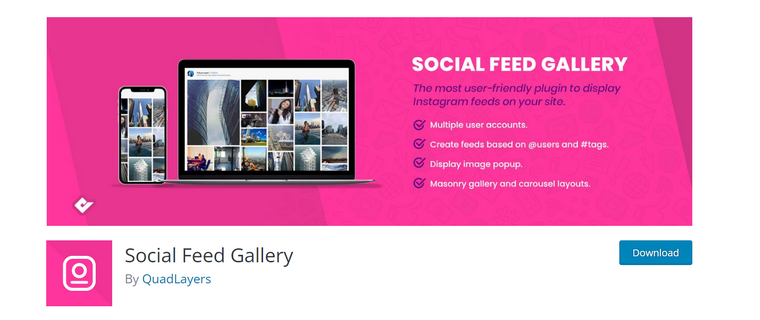
The simple Instagram Gallery plugin is easy to use and lets you embed a social feed, Instagram stories, the comment count, and tagged posts.
Pricing: free; premium starts at $49 a year.
Performance and Core Web Vitals: What You Should Keep in Mind
Instagram feeds look great, but they’re not free because they’re basically media- and script-heavy elements. Every feed pulls in external scripts, images, or videos, all of which can slow a page down if you’re not careful. And yes, this can affect Core Web Vitals.
The biggest mistake is trying to show too much. Ten or twenty posts might look impressive, but in reality, most visitors won’t scroll through them. Limiting the number of visible posts is one of the easiest ways to keep your pages fast.
Lazy loading is another must because your Instagram feed doesn’t need to load the second someone opens the page, especially if it’s below the fold. A good plugin (or custom setup) should load the feed only when it’s actually needed.
Caching also matters. Instead of requesting data from Instagram on every page load, the feed should be cached and updated periodically. It reduces server load and keeps your site responsive, even during traffic spikes.
When Not to Use Instagram Feeds on a Website?
With all the praise above, an Instagram feed isn’t a magic upgrade for every website. Sometimes adding one actually makes things worse, adding more noise, scripts, and less focus.
If your website is mainly informational, with long-form articles, documentation, or strictly focused on the B2B clients, an Instagram feed would add nothing because people come there to read, search, or solve a problem, not to scroll through photos. In that case, a social feed is just a distraction.
The same goes for brands with an inactive or half-abandoned Instagram account. If your last post is from six months ago, embedding that feed doesn’t build trust, but the opposite.
Performance-critical pages are another red flag. Landing pages built for ads, sign-ups, or fast conversions often need to load instantly and keep attention laser-focused. Adding an Instagram feed can slow things down and pull users away right when you want them to act.
There are also businesses where Instagram simply isn’t part of the decision process. Again, B2B services with long sales cycles, internal tools, or highly technical products don’t gain much from visual social proof. In those cases, clear messaging, case studies, or product demos usually work better.
To boil it down, if your Instagram content doesn’t actively support a business goal on that page and doesn’t get extra trust, clarity, or conversion, it probably doesn’t belong there.
FAQ
It can, especially if the feed loads many posts or external scripts at once. Using caching, lazy loading, and limiting the number of visible posts helps keep performance under control.
For most plugins and API-based feeds, yes. Basic one-off embeds of public posts can work without a Business account, but they come with limited control and styling options.
No. Only public posts can be embedded or pulled into a feed. Private content isn’t accessible through Instagram’s embed tools or API.
The feed may stop updating or disappear until the connection is re-authorized. That’s why it’s important to use reliable plugins and avoid placing critical content exclusively inside an Instagram feed.
Instagram embeds don’t add much SEO value in terms of indexable text. However, they can improve engagement signals like time on page, which indirectly supports SEO.
In most cases, 4–8 posts are more than enough. Showing more rarely adds value and can negatively affect loading speed and user focus.
To Sum Up
Instagram is a full-scale business platform that helps brands build trust, show real customer experiences, and support sales, especially in B2C niches where visuals and emotion matter.
When used intentionally, an Instagram feed can do a lot of heavy lifting on a WordPress website and keep pages fresh, add social proof, and show how real people interact with your product or service. The key is not to add a feed just because it looks nice, but to place it where it actually supports a goal.
The good news is that WordPress gives you plenty of ways to do this without overcomplicating things. You can embed individual posts with code when you need full control, or use plugins to build dynamic feeds with filters, hashtags, and styling options.
Hopefully, the examples, best practices, and tools covered in this article help you use Instagram more thoughtfully on your website and turn social activity into something that actually works for your business.