Search filter is a tool or feature that allows users to refine their search queries to find specific content on a website more easily. This functionality is typically used on websites with a large amount of content, such as blogs or eCommerce sites, where users may need help narrowing down their search results.
For example, a search filter on a blog could allow users to filter search results by category, tag, or date to find articles more relevant to their interests. On an eCommerce site, a search filter could help users find products based on criteria such as price range, brand, or product type.
Search filters can improve the user experience by making it easier for users to find the content they’re looking for, reducing frustration, and increasing engagement with the website.
Cases for Using a Search Filter on Different Website Types
It’s clear that a search filter is crucial, but let’s delve into specific use cases for particular website types to understand its importance even better and talk about the best combinations with other filter types.
E-commerce websites
- Allowing users to search for products within specific categories, such as clothing, electronics, or home goods.
- Search by keywords, focusing on those in the product name and description, to find phrases like “blue dress” or “wireless headphones.”
- Selecting specific product attributes so users can refine their search based on specific product attributes, such as size, color, or material. This can be implemented using a Search filter, but a Select filter might be a better option.
- Faceted search is the best solution for eCommerce websites with a lot of various goods, as it allows for the quick narrowing down of search results by applying filters based on different attributes or facets of the content.
Real estate websites
- Search for properties based on their type, such as houses, apartments, or commercial properties.
- Search by location, such as city, neighborhood, or ZIP code.
- Search by keywords in the description and attributes to search for properties using keywords related to their search, such as “3-bedroom house” or “waterfront property.”
Job board websites
- Search for jobs based on specific job titles or keywords related to the particular position.
- Select the prefereed location based on the user’s location.
- Search for jobs based on specific company names or keywords related to certain employers.
Content-rich blogs
- Keyword-based search, so users can find blog posts using keywords related to their interests, such as “technology trends” or “travel tips.”
- Search for blog posts written by specific authors or contributors.
- Readers can search for blog posts within specific categories, such as “technology” or “food.”
Other website types that definitely need filters
- Directory/listing websites;
- Event calendars;
- Booking and appointment websites, etc.
In each of these use cases, search filters help users find relevant content or information more quickly and efficiently, enhancing the overall user experience of the WordPress site.
Effective WordPress Website with JetSmartFilters’ Search
As we can see from the previous section, the most effective results and user experience are possible with the combination of various filters. Hence, a comprehensive solution such as JetSmartFilters is the best option, working with Gutenberg, Bricks, and Elementor.
As you can see in this video, there are a lot of options and settings this plugin can offer:
The search filter field is great for more refined results when searching within particular categories or meta fields.
You can easily specify these query variables here:
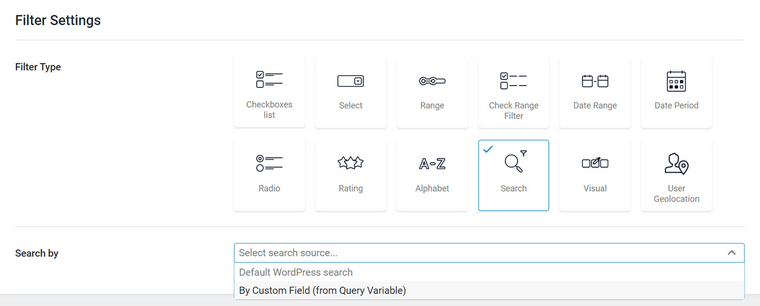
This comprehensive guide explains how to add one or multiple query variables and set as many search filters as needed. Note that the plugin demonstration is made for Elementor here, but it works equally well with Block Editor or Bricks.
In the JetSmartFilters 3.7.0 Release, a new provider was introduced – JSF Listings. Now, the JetSmartFilters plugin can be used not just as a filter, but also as a content grid or list builder, and can be completely independent from WooCommerce, Elementor, or Bricks content loops or JetEngine’s Listing Grid.
Of course, you can and should still use them, but also, from version 3.7, you have the freedom to utilize one more dynamic content provider if needed. The new Listing Builder utilizes the Block Editor, enhanced with additional styling settings, to build a listing (loop) item. And then, there is a corresponding block, widget, and element for Block Editor/Elementor/Bricks, respectively, to insert the grid into your page.
Search Filter vs. Website Search: What’s the Difference?
For the most effective user experience, consider using both JetSmartFilters and JetSearch. The latter is ideal for general searches, such as those to be featured on the main page. It offers numerous settings to fine-tune the search.
This plugin also features a Search Suggestion tool, allowing you to guide your clients to the products or categories you want to promote, or simply help them achieve the best results.
Although both JetSmartFilters and JetSearch allow users to find content, they serve different purposes. The Search Filter by JetSmartFilters refines the results displayed on a specific page or within a certain listing grid. It only works within the defined query, such as a product grid, a post archive, or a directory listing. When a visitor types a keyword in the Search Filter field, it filters those particular results in real time, using AJAX, without reloading the page.
JetSearch, on the other hand, works as a global website search engine. It scans your entire WordPress database, including posts, pages, custom post types, and even custom fields, to show the most relevant results site-wide. This is the tool you would typically place in the website header, sidebar, or homepage. Of course, you can fine-tune it to apply search only to particular post types or categories, but the whole idea is different.
So, to boil it down:
- JetSmartFilters Search Filter filters what’s already displayed on the page.
- JetSearch searches everything on the website, regardless of what’s currently visible.
The difference also affects performance and user goals. The search filter is ideal for structured pages where the visitor already knows the context, for example, filtering “laptops” by brand or price within a product catalog. JetSearch is better suited for open searches when the visitor doesn’t yet know where to look, such as typing “wireless mouse” from the homepage.
Both tools complement each other perfectly. You can use JetSearch for global discovery, then combine it with JetSmartFilters on specific pages to let users refine the results further.
Human-readable URLs for filters
By default, after applying filters, the URL often turns into a long string full of special characters and parameters. These links are not user-friendly and can’t be easily shared or understood. By enabling human-readable URLs, you make the address clear and meaningful, for example:
/products/shoes/men/size-42 instead of /shop/?filter_color=blue&filter_size=42.
It’s not only more intuitive for users but also better for SEO. Search engines can crawl these URLs, index filtered pages, and improve visibility for niche search queries.
Watch this detailed video guide to see how to set it up correctly and handle multiple filter combinations.
See the result count immediately
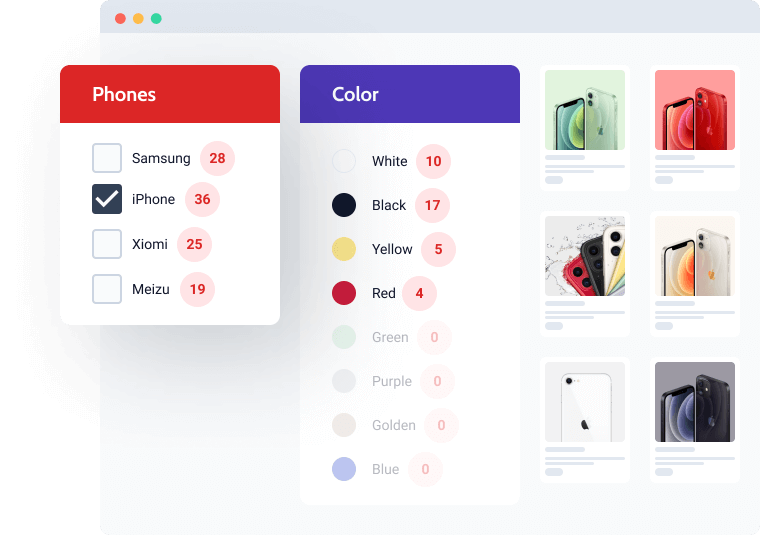
The Indexer feature displays the number of results available for each filter before the user applies it. This small detail improves both performance and user experience. Visitors instantly know which options have content behind them and which ones don’t, saving time and frustration.
For example, if a user sees “Size 42 (12)” next to a filter, they already understand that twelve products match that selection. This feature also prevents empty results and helps users make faster decisions. The image below illustrates how the Indexer updates dynamically as filters are applied.
Tips and tricks on redirecting to predefined results or pages
Sometimes, it’s helpful to send visitors directly to filtered results instead of making them apply filters manually. This approach works great for curated collections, seasonal offers, or “top-rated” sections.
For instance, you can create a link that opens a page already filtered by “On Sale” and “Free Shipping.” Users land directly on what matters, reducing clicks and increasing conversions. It’s also a neat way to promote specific product groups or content categories from newsletters or banners.
You’ll find several variations and examples in this article, including how to use redirect parameters correctly and how to preserve filters when combining them with JetSearch results.
FAQ
It’s a field where user can type their keywords (any text) and get corresponding results.
No, you don’t. JetSmartFilters is a coding-free plugin.
A search filter is used to refine your search results on a specific page, whereas a search plugin, such as JetSearch, enables a global website search.
Bottom Line
In this article, we explored practical ideas for implementing search and other filters on WordPress websites. Search filter is an absolutely necessary element for almost any website, unless it’s very small, especially if we are talking about eCommerce or Directory sites.
With JetSmartFilters and JetSearch, you can implement a powerful AJAX search engine on your website with numerous flexible settings and space for optimizing the clients’ experience.