Rural tourism often gets sidelined by large platforms focused on mainstream destinations, leaving small towns and local events with limited visibility. Over a decade ago, Rafa Mérida, a seasoned web developer from Málaga, spotted this gap and decided to tackle it head-on. He launched Pueblea, a non-profit side project aimed at giving rural communities a stronger online presence. He has shared his story in WordCamp Granada 2024.
What makes Pueblea stand out is not just its mission, but the way it’s built. Instead of relying on bulky third-party plugins, Rafa took a streamlined WordPress approach, using Crocoblock plugins and, in particular, the Custom Post Types functionality to create a scalable and easy-to-manage event system. The result is a fast, efficient site architecture tailored for promoting local events without the overhead.
Event Management Without Plugins: Custom Post Types Instead of Event Plugins
Pueblea’s biggest advantage comes from its deliberate choice to avoid traditional event plugins. Rafa and his team, with over 15 years of WordPress experience and more than 300 projects under their belt, recognized a common problem: standard WordPress posts often confuse users because the post date rarely matches the actual event date. On top of that, popular event plugins like The Events Calendar, Event Manager, or EventON were considered too bulky and inefficient for the project’s specific requirements.
Instead, Pueblea relies on Custom Post Types (CPTs) to create a lean, tailored event management system designed specifically for rural events.
Early on, towns were treated as a taxonomy linked to events, but the team quickly moved to a more scalable solution of two main CPTs – one for Events and another for Towns. This setup not only improves flexibility but also lays the groundwork for future expansion. For example, the Town CPT can be extended to include related content such as points of interest, local businesses, or accommodations, all connected through relational links.
The relationship between events and towns is many-to-many. While most events take place in a single town, some, such as festivals, span multiple locations simultaneously. Conversely, a single town can, and often does, host multiple events. An example given was a charity organization holding a fundraising fair simultaneously in 20 towns, which required a special format.
Event CPTs include custom fields for all key event details and event categories, which are around 10 to 12 types and are managed through taxonomies. This structured and scalable design, inspired by the team’s work on the WordPress Málaga site, showcases a forward-thinking approach that prioritizes performance and long-term maintainability.
Before, towns were structured as a taxonomy under events. However, this proved less scalable. By separating towns into their own CPT, future expansion becomes more feasible; for example, a town CPT could later integrate points of interest, businesses, or rural accommodations through relationships.
Design Challenges and Solutions
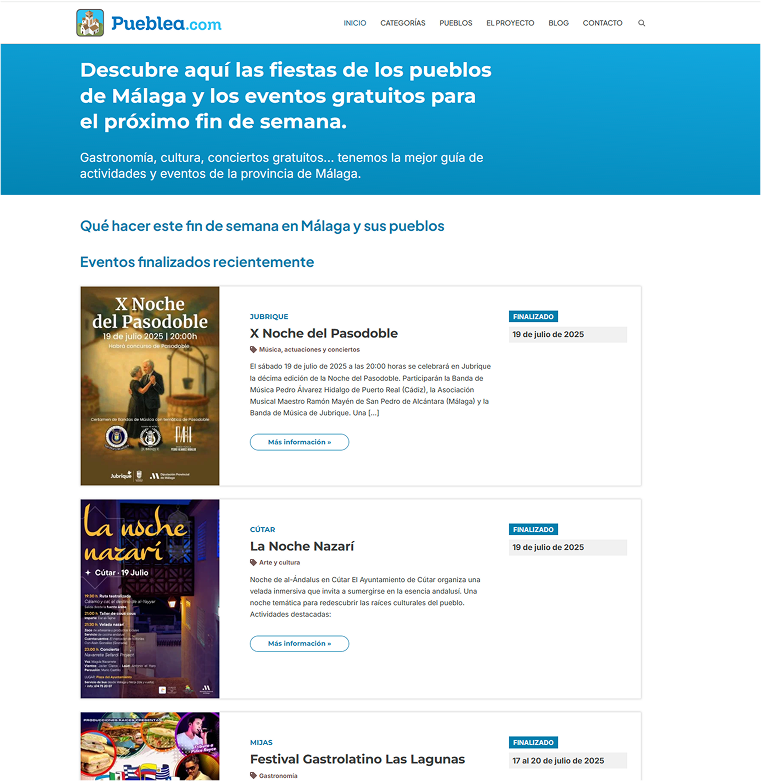
Pueblea’s design prioritizes ease of use and immediate event visibility, aiming to place event information at the top, without unnecessary decoration or excessive details. Over the past 10 years, the homepage design has evolved to ensure that upcoming events are prominently displayed immediately.
A key design challenge arises from the diverse formats of event posters received. These posters are often created by amateur designers, resulting in all kinds of formats – vertical, slightly too wide, horizontal, and even square ones from local government. This inconsistency makes it very complicated to create a coherent visual grid.
The team experimented with different grid layouts. Initially, upcoming events were organized in two columns. However, this led to visual gaps when there was an odd number of events. They even considered placing designed advertisements to fill these gaps, but decided to remove them in the end.
For mobile, a carousel was implemented when the number of events was odd, but users found it unintuitive and often missed additional slides, thinking there was only one event that weekend. The carousel idea was also discarded.
The solution for the main event listings was to adopt a single-column layout. This final grid structure means that odd numbers no longer leave gaps, providing a clean and consistent display. For past events on the homepage, a two-column grid is used, where the issue with odd or even numbers is resolved due to a buffer of 3,000 events, ensuring that consistent even numbers are always displayed.
Date formatting also received significant attention. Instead of conventional date formats like 26/10/2024, formats, custom shortcodes, or JetEngine callback functions are there to display dates more naturally, such as October 26–27. This involves various conditional date strings that consider event duration, start and end dates, and whether an event spans different months, enhancing readability.
The homepage is structured with three timelines:
- this weekend’s events;
- upcoming events;
- past events.
Events are added as far out as, let’s say, “next January.” The platform prioritizes free and low-cost events, focusing on rural, cultural, and gastronomic themes, and explicitly excludes events related to bullfighting or hunting.
💡 Learn how to display past and future events dynamically using JetEngine.
Filters and Event Sorting
Pueblea employs sophisticated methods for filtering and sorting its extensive event database. Conditional logic is used to automatically sort events into categories like “This Weekend,” “Upcoming,” or “Finished,” eliminating the need for manual date adjustments and ensuring dynamic placement.
For search and filtering functionalities, Pueblea integrates JetSearch and JetSmartFilters from Crocoblock. JetSearch provides an autocomplete feature, while JetSmartFilters allows users to filter events by town or category. To ensure search results are relevant and not cluttered, Pueblea uses relevancy weighting, ensuring that “only events” appear in search results, preventing posts or town names from interfering.
The event prediction system has also been developed. This system queries past events within a ±1-week range to anticipate annual events. For instance, if last year featured the 26th Mule Fair and 10th Bandit Passion, the system can infer the likelihood of the 27th and for the current year. This aids the team in proactively checking town hall websites to copy event details, tweak the text, and update the date, which saves considerable time given the lack of official updates. Manually tracking 103 towns would be impossible otherwise.
All custom database queries, including checks for “events today, tomorrow,” are handled using JetEngine’s Query Builder, which now includes an AI feature.
Homepage and Archive Architecture: Custom Archives and Single Pages
The site is built using Elementor’s Theme Builder to create custom archive pages, single-event pages, and single-town pages. The entire page is optimized for loading speed and is reportedly already achieving great performance metrics.
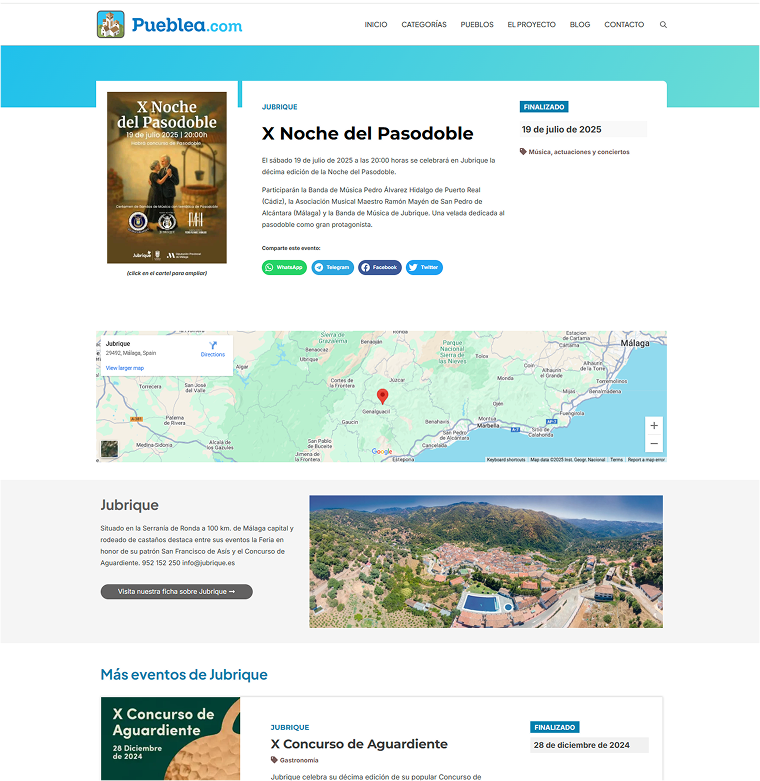
A single event page typically includes the event poster, and can feature an attached photo gallery, screenshots, or an external link button for more information. Past events are clearly marked with a “Finished” tag. Below the event details, a Google map of the town and a summary of the city are displayed, with a button to view the full town profile.
The photos used to illustrate the 103 towns were provided by two friends, who also do not monetize their work, in exchange for credits and links.
Scrolling further down on an event profile reveals “more events from QTAR,” listed from most recent to oldest, featuring an infinite scroll to load additional events as the user scrolls.
Plans to Migrate to Bricks Builder
Currently, Pueblea is built with Elementor. However, the team has active plans to migrate the entire website to Bricks Builder in the coming weeks. This decision stems from the belief that Bricks Builder is much more efficient, despite the site already demonstrating great performance metrics. This migration highlights their ongoing commitment to optimizing the platform’s efficiency.
The project operates without any institutional funding or grants, relying on the team’s dedication. They manage all aspects themselves, stating a motto that “We’re moving forward, with or without help.”
The site barely covers its hosting costs, and although it uses AdSense, the team will consider ditching it if it lowers performance below 90%. They have explicitly chosen not to accept institutional funding, as it could introduce commitments that would restrict their editorial freedom, such as refusing to publish events like bullfights or hunting dog fairs, or super commercial events. They prioritize local, free, or low-cost events.
Organizers do not submit events directly to the platform, but the team manually adds them. Giving towns access was considered but rejected due to concerns about poor content formatting, with a humorous example of someone uploading a councilman holding the event poster instead of the actual poster.
The URLs for annual events, such as different editions of a Ham Festival, are not the most optimal but still achieve very interesting search results and rankings. Pueblea ranks the number one for searches like “eating for free in Málaga,” “free concerts in Málaga,” and “town festivals in Málaga,” and often appears in the top five for more obscure local events. This indicates the lack of attention these small towns receive from other platforms, allowing Pueblea to dominate search results.
📺 The full presentation can be watched here.
FAQ
Using WordPress Custom Post Types (CPTs) with tools like Crocoblock, particularly JetEngine’s Query Builder, enables you to build a lightweight, scalable event site without relying on resource-heavy plugins. It gives you full control over fields, filtering, and relationships between content types.
You can create a separate Custom Post Type for locations or towns and link them to events using relational fields. This setup makes your site more flexible and easier to expand over time.
For many custom use cases, especially when speed and flexibility are a concern, CPTs are often the better choice. If used with a powerful querying tool like Query Builder, you might not need any external plugins.
Takeaway
Pueblea’s case shows that you don’t need heavy plugins or big budgets to build a powerful, scalable event platform. With the smart use of WordPress Custom Post Types and Crocoblock tools, even small rural communities can have a fast, flexible site that puts their events front and center. It’s a reminder that thoughtful architecture and community-first values can go a long way, especially when performance and purpose go hand in hand.