In this article, you will find a lot of statistical data about the state of eCommerce worldwide, the state of WooCommerce 2026 new features and its improvements and downsides, recent updates that really matter, as well as the pain points that should be fixed or have workarounds. And, of course, mention some predictions about the future.
Make yourself a cup of tea, it’s a very interesting conversation! ☕
eCommerce Market in 2026
Straight to the point – according to EMARKETER, eCommerce sales reached $6.4 trillion last year. A market share of WooCommerce is 20-37%, and the estimated GMV is $30-35 billion.
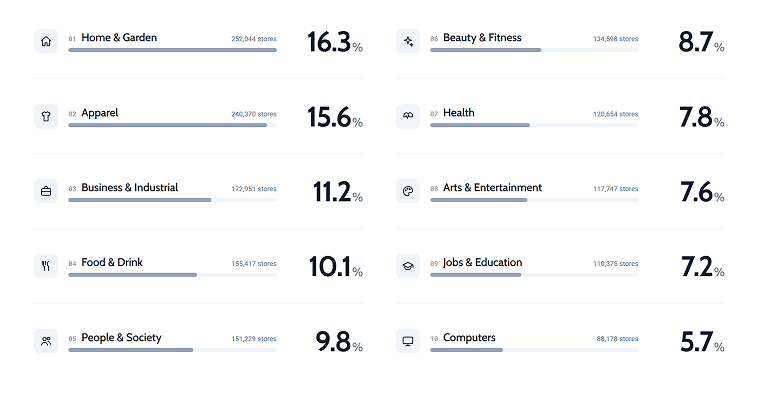
I was quite surprised when I learned the most popular industries in eCommerce, while I was sure it’s more about the Apparel niche, the leading niche is very different.
However, all these statistics come from different sources, so the data isn’t bulletproof accurate.
So yes, looking at these numbers, we can definitely be sure that it’s a serious market, but it’s also obvious that AI is dramatically accelerating development speed. What could have taken five years to build just a few years ago can now be achieved in a matter of months. That means that even a small gap between competitors can disappear very quickly.
WooCommerce market share (eCommerce market)
This is a breakdown, and we talk about the share of the eCommerce market worldwide (not all the sites):
| Platform | Global eCommerce market share | Estimated active stores | Deployment model |
| WooCommerce | 37% | 6.5+ million | Open-source (WordPress plugin) |
| Shopify | 21% | 4+ million | SaaS-based |
| Wix eCommerce | 14% | 2.4+ million | SaaS-based |
| Squarespace | 9% | 1.2+ million | SaaS-based |
| Magento | 7% | 200,000+ | Open-source and Enterprise |
| BigCommerce | 5% | 150,000+ | SaaS-based |
| PrestaShop | 3% | 300,000+ | Open-source |
| Others (Custom, OpenCart, Salesforce, etc.) | 4% | 500,000+ combined | Various |
Source: AppMySite
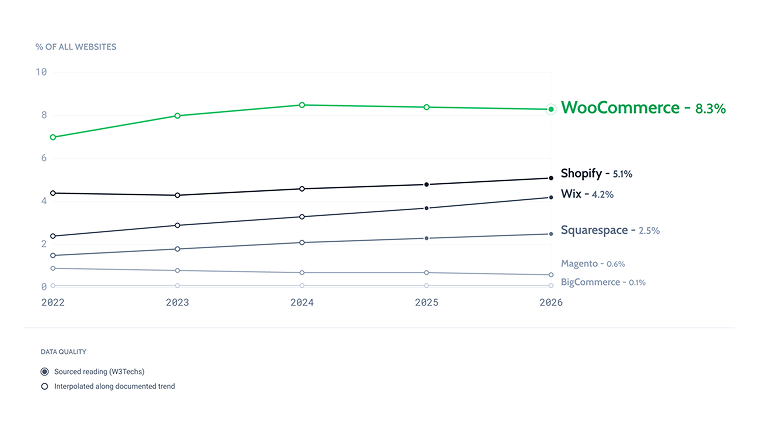
But the most important here is not even plain numbers but the trend. While WooCommerce is on a plateau, Shopify and Wix are obviously growing – and I will return to the details and reasons later in this article. As a spoiler, I can only say that WooCommerce is still quite cumbersome in this very fast reality.
This is a market share of all websites, not only eCommerce:
Now, let’s concentrate on WooCommerce: which countries prefer it over others? Look at this chart:
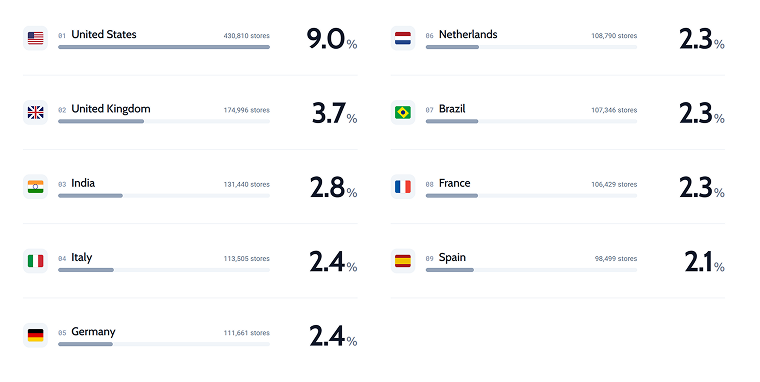
I can assume that the reason why WooCommerce shows up strongly in two different types of markets is for two different reasons.
The US and UK are there because of sheer volume (US) and a deep WordPress developer ecosystem (lots of agencies and freelancers defaulting to it).
India, Brazil, Italy, and Spain, in their turn, are there because of cost sensitivity and a preference for owning the stack rather than renting it. Germany and the Netherlands sit in between, driven more by data sovereignty and self-hosting culture than by price.
However, it would be absolutely great to know your opinion – feel free to open a discussion in the Facebook Community.
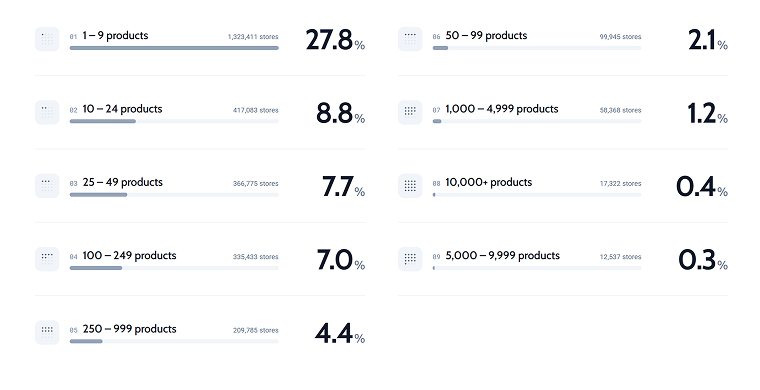
And this one here is even more important statistic for marketers and agencies: it obviously states that WooCommerce is for small and medium enterprises.
The state of WooCommerce in 2026
Let’s have a look at a year of WooCommerce, and see what proper changes and improvements took place.
Scaling capabilities are now built in by default
WooCommerce High Performance Order Storage (HPOS) is the most important architectural shift WooCommerce has made in the past five years, and it crossed a meaningful threshold in 2026. HPOS replaces the legacy approach of storing orders inside WordPress’s general wp_posts and wp_postmeta tables with dedicated, indexed tables built specifically for eCommerce workloads. The change matters because it removes the single biggest scaling bottleneck for high-volume stores. HPOS itself shipped as the default for new installations back in late 2023. Still, its caching layer remained experimental until 10.4 graduated HPOS Datastore caching from experimental to a standard feature option in December 2025. From that point on, Woo’s flagship scaling primitive is a recommendation, not a beta toggle.
The analytics pipeline got a parallel rebuild. WooCommerce Analytics in 2026 is built around batched order processing – a meaningful difference for any store doing serious volume. 10.5 (February 2026) introduced scalable analytics for high-volume stores, processing data in scheduled batches rather than one order at a time. For stores with thousands of orders a day, that’s the difference between an admin dashboard that responds and one that doesn’t.
Storefront performance got some teeth
10.4 quietly made the Interactivity API Mini Cart the default, replacing the React-based implementation that had been opt-in. The new version uses native WordPress primitives, ships less JavaScript, and updates the cart optimistically – the click-to-update lag most stores live with is now gone.
10.6 brought a change that’s smaller but more universally felt: starting with WooCommerce 10.6, all images from the Product Image block are lazy-loaded by default, with a new woocommerce_product_image_loading_attr filter for developers who need to override the behavior on above-the-fold images. WooCommerce lazy load product images is now the default behavior rather than something every store has to plug in separately. Combined with the cart and checkout block refinements that landed in the same release, the storefront layer is faster out of the box than it’s been in years, improving WooCommerce checkout optimization.
AI and agentic foundations were laid
This is the cluster most stores haven’t noticed yet, but it’s the one that will define the next two years. 10.3 (October 2025) introduced the WooCommerce MCP beta – the Model Context Protocol that AI assistants like Claude, Cursor, and VS Code use to read and write data through a standardized interface. With MCP, you can connect an AI assistant directly to your store and ask it to update prices, query orders, or generate descriptions, without writing a single line of integration code.
10.7 in April 2026 was framed around performance, analytics, and a better Store API – positioning the Store API as a first-class developer surface.
10.8 in May 2026 shipped a new email template sync system that tracks version metadata on every block-based email, plus multiple query reductions across HPOS order queries and REST API serialization, preparing the platform for the higher-frequency programmatic access that agentic tools generate.
The quick reference of what shipped, in order:
| Version | Released | What it changed |
| 10.1 | Aug 12, 2025 | Faster Checkout block, two new Product Collections, and decimal quantity support |
| 10.2 | Sep 16, 2025 | Product Collection Carousel, Cross-Sells block, Taxonomy Filter block |
| 10.3 | Oct 21, 2025 | Cost of Goods Sold in core, MCP beta, and address autocomplete at checkout |
| 10.4 | Dec 10, 2025 | Interactivity API Mini Cart default; HPOS Datastore caching graduates |
| 10.5 | Feb 3, 2026 | Batched analytics for high-volume stores, multi-package shipping display |
| 10.6 | Mar 10, 2026 | Product images are lazy-loaded by default; Cart/Checkout refinements |
| 10.7 | Apr 14, 2026 | Store API as first-class surface; performance and analytics push |
| 10.8 | May 26, 2026 | Email template sync; N+1 query reductions; custom shipping providers; WordPress 6.9 minimum |
The non-obvious challenges for WooCommerce stores
So, while we speak about all these frills, there’s such an obvious and very powerful thing as mobile traffic. I tried to get an exact number of that traffic, and depending on the source, it varies between 65 and 80%.
Anyway, as humans, we know that feeling of staying on a couch and shopping, don’t we? Let’s assume it’s just 60%, and the question is – is WooCommerce ready for it? To be beautiful, channel the brand voice, and attract leads?
Well, I’ve been there, and WooCommerce is not about the design and attractive front end. It’s already a very powerful system, so if you are looking for ways to boost the store, there are two ways to do it:
- Custom CSS and hooks;
- Visual Builders with dedicated WooCommerce builders like JetWooBuilder.
So, most of the WooCommerce market is for small or medium-sized shops, which means that there’s no need for an over-the-top level of optimization – e.g., to handle thousands of goods at once. So, you can build serious WooCommerce stores that meet all the requirements for WooCommerce multichannel selling.
What it should do is to capture attention and have a great mobile UX and WooCommerce ux best practices.
Once, the Crocoblock dev team conducted an experiment to challenge whether the products can face the strict requirements for all kinds of filters – read the result here – in short, yes.
There’s a trap in describing WooCommerce in 2026: to confuse features with stores. The platform shipped a lot of features. That doesn’t automatically make stores mobile and fully UX-optimized. This is the whole point – you have full control, so it’s up to you.
Where JetWooBuilder picks up
This is the work native WooCommerce hasn’t done and probably won’t, because it’s not core-platform work, but it’s up to the design system and the store owner’s expectations.
The architecture and role of JetWooBuilder as Crocoblock WooCommerce store builder are straightforward: it gives you template-based control over single-product pages, archives, cart, checkout, and account screens, using Elementor as the editor.
You compose layouts the way you’d compose any other page, but with WooCommerce-aware widgets that pull live product data. The result is a JetWooBuilder WooCommerce custom product page that looks like your brand, not like a default Woo template.
You can optimize it for mobile, tablet, or other custom device sizes.
WooCommerce and AI: Opportunities and Risks
As in every article in 2026 that talks about trends, I should mention AI, and there are many reasons to do so, actually.
Threat #1: Security
So, now many users can vibe-code additional functionality. Still, when it comes to WooCommerce, which is a secure platform that deals with a lot of forms, secure data, and transactions, the number one concern from AI is security. And it’s a real risk, not just an assumption.
This conversation is worth paying attention to, and there’s one idea I completely agree with: commercial plugins have a major advantage in terms of stability and security. Their development teams work not only with professional testers, but also receive feedback from thousands of real users who push the product in every possible direction. That real-world usage helps shape the product, uncover edge cases, and continuously improve security.
For example, one discussed case involved a plugin generated with one of the most powerful Anthropic Claude models. Yet, it still contained around 100 security issues – something completely unacceptable for a production-ready plugin.
Patchstack also reports a growing number of vulnerabilities, most of which are severe.
Threat #2: AI-powered SaaS tools have lower switching costs for SME
Small and medium enterprises are the target market for WooCommerce. For entrepreneurs who are just starting their journey in eCommerce, it’s easier to do it using a system where everything can be set up within minutes and have AI integration – even if you pay a commission for each transaction.
And while WooCommerce is quite slow in the implementation of new features, it’s a really dangerous threat.
Threat #3: Decline of traffic from search engines
Search engines lost around 20% of traffic (and will lose even more with wider adoption of AI), as users find what they need from AI, without going through multiple search result pages. If before, users may have found your store because of the blog post or images, now they just get the main idea from AI, and that’s it. So, it’s about a big battle for attention and definitely about adopting new ways to attract it.
Threat #4: Agentic commerce
When AI offers you goods, it doesn’t control an order and the way they are shown – neither WooCommerce nor Shopify can control it fully. Actually, the way to do it is Model Context Protocol, which WooCommerce supports. But the most aggressive move came from a rival: Shopify launched an Agentic Plan that lets WooCommerce, Magento, and other non-Shopify merchants surface products in ChatGPT, Gemini, and Copilot using Shopify’s infrastructure, positioning it as the middleware layer for AI commerce even for competing platforms.
There’s a much bigger conversation that lies in the agentic commerce angle, actually.
Opportunities
The biggest opportunity for WooCommerce is to quickly adapt to challenges and address threats, especially the latter three of them, and properly use the fact that it’s an open-source tool where the store owner actually owns everything, so they should properly feel this advantage in everyday operations.
WooCommerce vs. Shopify in 2026
As it’s clearly visible from the WooCommerce market share graph, the main rival of WooCommerce now is Shopify, and it’s something we can’t ignore anymore. So, recently, the Checkout Summit took place, and I liked this session by Katie Keith from Barn2, where she breaks down these myths and talks about the real advantages of WooCommerce compared to Shopify.
❌ Myths to drop:
- Shopify isn’t flexible.
In fact, it is, via APIs and hooks, just like WooCommerce. - Merchants care about open source and data ownership.
They actually care about practicalities: cost, integrations, and day-to-day usability. - WordPress has a uniquely amazing community.
The Shopify community is just as welcoming.
✔️ WooCommerce’s real strengths:
- Better for complex business models where commerce is part of a bigger platform (memberships, LMS, advanced content, events).
- No dependency on a single company if your host or even Automattic fails, you can move, or someone will fork it. Shopify can suspend your store at its discretion.
- Generally cheaper at scale once apps and plan upgrades are factored in; hosting is competitive.
- More infrastructure control is important for an enterprise (Shopify Plus starts at ~€2,000/month, which buys a lot of premium WooCommerce hosting).
- More flexible in specific areas, especially checkout customization.
However, WooCommerce has a kind of weakness, just as its biggest strength is WordPress. Or, better to say, just the fact that while Shopify is eCommerce-first, as it’s literally why it exists, WordPress is a much wider platform. And if WooCommerce wants to attract interest, the team should at least rethink the admin part.
FAQ
WooCommerce holds roughly 20–37% of the global eCommerce market, depending on the source, with over 6.5 million active stores.
Neither is universally better, as they win in different segments. WooCommerce is stronger for merchants who want full control, lower long-term costs, and ownership of their data and stack; Shopify is faster to launch, easier for non-technical owners, and more aggressive on AI and agentic commerce features.
Out of the box, WooCommerce is functional on mobile but not optimized for the conversion-driven mobile UX modern shoppers expect. Most stores need either custom CSS and hooks or a dedicated visual builder like JetWooBuilder to deliver a polished, mobile-first experience.
Yes, since version 10.3 (October 2025), WooCommerce ships a Model Context Protocol (MCP) interface that lets AI assistants like Claude, Cursor, and VS Code read and write store data directly. You can ask an AI assistant to update prices, query orders, or generate product descriptions without writing custom integration code.
Takeaway
WooCommerce in 2026 is more capable than it’s ever been, finally taking the HPOS as mainstream. The storefront is faster by default, MCP is shipping, and the architecture is finally ready for serious volume.
But I’m still having higher expectations for this platform, as it should move much faster, I guess, to deal with competitors. What do you think?