The WordPress Admin Panel, also known as the admin dashboard, is essentially an instrument panel for setting up and managing the entire WordPress site. To access it, you must first pass through the login page. The login page is the first screen that appears when you start working with your business or blogging site. While in some cases, it’s totally appropriate to leave the default WordPress login page unmodified, creating a custom login page can improve user experience, enhance the site’s sellability, and even help develop your company’s branding. This article will justify the importance of customizing login pages and discuss the most convenient methods for doing so, with a focus on plugin solutions.
Why Is It Better to Customize WordPress Login Page?
WordPress powers nearly half of all websites on the Internet. Users with no coding experience get access to sophisticated yet easy‑to‑learn tools to create unique, professional‑looking sites. Considering the abundance of modifiable WordPress themes and building plugins, webpages with default designs are becoming increasingly rare. Frankly, paying for a website and finding exact elements that appear on other pages may feel a bit diddled.
So, when is it OK to leave the WordPress login page untouched? It is only appropriate if you have created a website and you are the only person with access to the admin panel. In all the other situations, being able to modify a login page and add new features brings many benefits. And here is why.
Many users are aware of the customization options available for the front end of WordPress sites. However, most of them will be surprised to learn that the backend of their websites is just as flexible as the front end. A login page tailored to their needs will increase their confidence in their website developer. Why?
- First, it demonstrates your deep understanding of the WordPress platform.
- Second, it shows you’re attentive to every detail and committed to delivering a fully customized experience, which sets you apart from less detail-oriented developers.
Apart from uplifting a brand’s identity, a custom login page provides a unique user experience, improved navigation, and even enhanced site security.
What Can Be Customized?
The default WordPress login page isn’t exactly appealing to look at. Upon accessing it using your favorite method, you’ll be presented with the WordPress logo followed by the login form. It consists of:
- Username and Password input fields;
- a “Remember Me” checkbox;
- a “Log In” button.
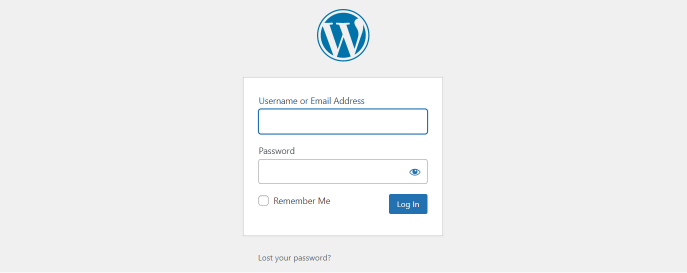
The standard login page has just enough functionality, but what about all the gray space around the login form? Is it possible to do anything about it? Sure, read on.
The visual appearance of the page
Imagine running a website and inviting visitors to sign in to get premium content. On their way to a premium account, they must go through a dull login page that looks nothing like the rest of your site. Some visitors may find it suspicious. Others may notice that this part of an otherwise beautiful website was overlooked by the designer.
Customizing the login page may deliver the most value to website members even before they log in. Every element can be modified to follow branding regulations. Changing the WordPress logo is one thing that almost everyone does when creating a custom WordPress login. Changing fonts, colors, opacity, and gradients of a login form is another option frequently used to enhance user experience. However, a real game-changer is experimenting with the background. Go ahead and add an image or a video, or combine a few pictures in an animated slideshow.
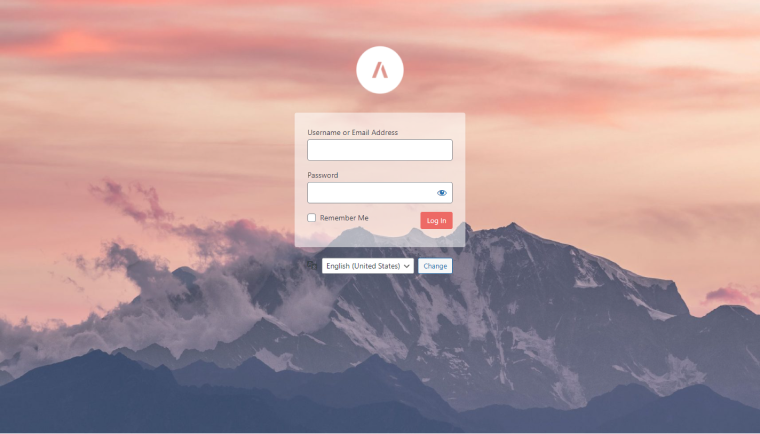
Using opacity instruments with the background image and login form may create a unique effect on the site and the login page’s singleness. This way, visitors don’t feel like they must leave the site to log in. You can even style the login form like a pop-up with your homepage as a background.
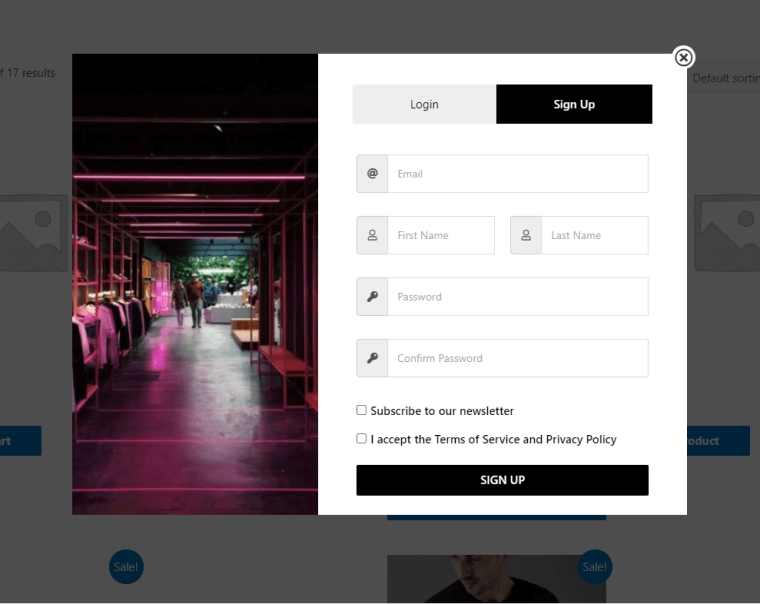
Adding new functional features
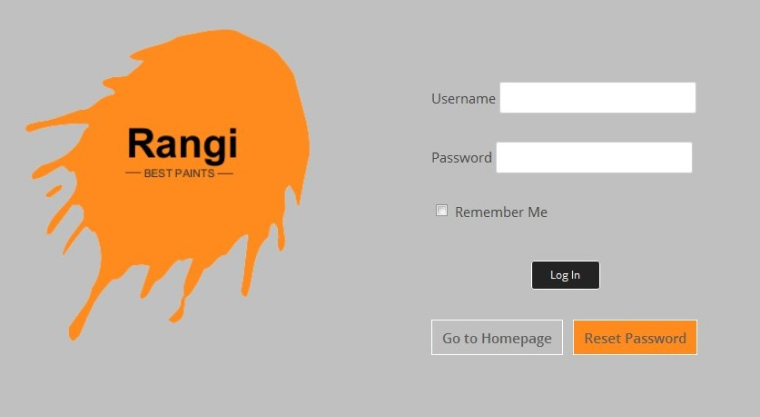
Creating a custom WordPress login is not only about adding colors, pictures, fonts, and other visual effects. The empty space around the login form can be used to promote something on the page. A widespread practice is to split the screen into two columns, where one column contains the login form and the other highlights specific aspects of your business. It can include navigation links or various calls to action.
There’s a great option to create a social login in WordPress if you want to allow users to log in and register using widely popular apps like Facebook, LinkedIn, and Google accounts, among others.
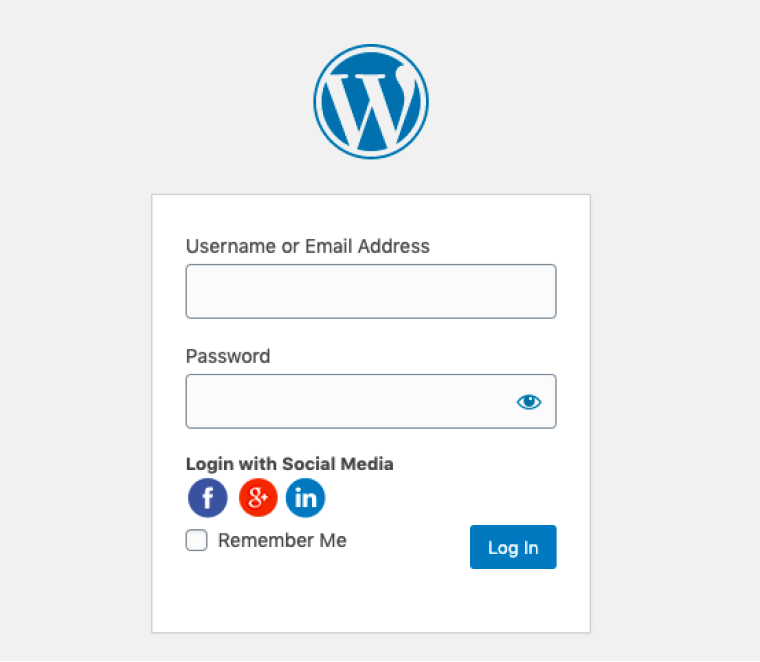
This way, users’ profiles from social media accounts sync with the website, and they don’t need to create a new account just for registration on one site.
Say goodbye to standard WordPress error messages and make the login page styling more personalized. Typical error messages like “Invalid Username” and “Invalid Password” provide hints to someone trying to gain access to an account unrightfully.
Finally, set up a reCAPTCHA in the WordPress login form to effectively fight spambots.
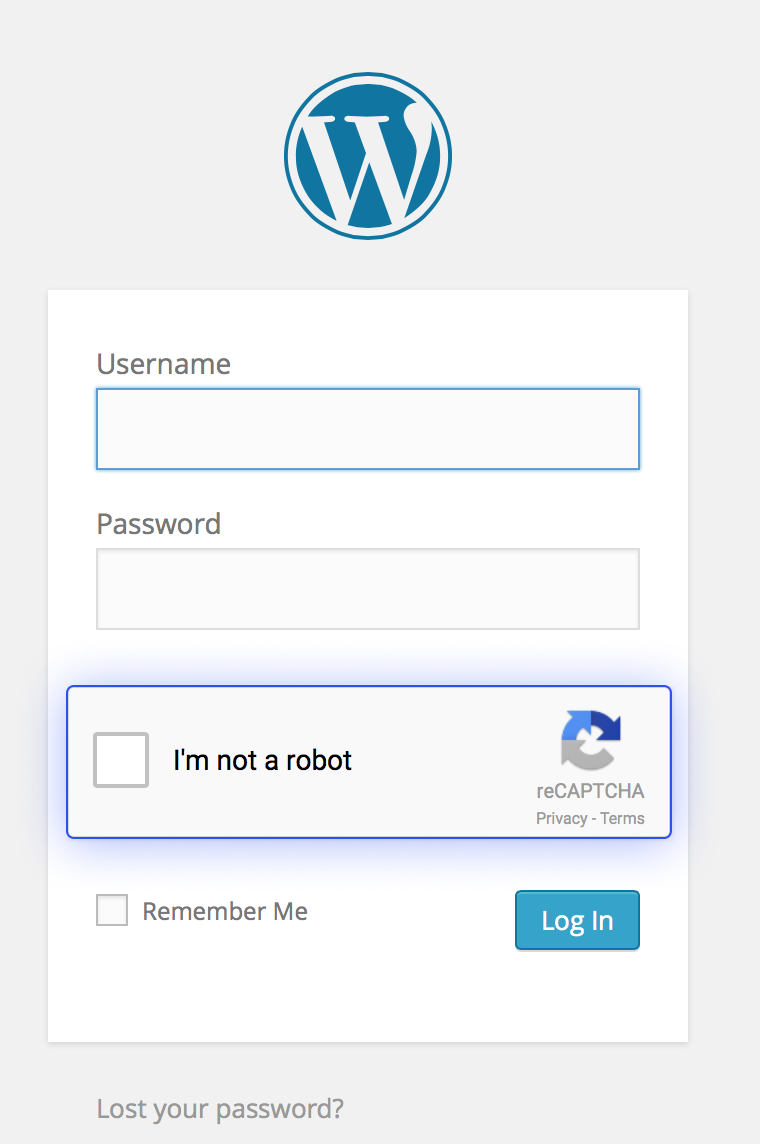
There are many features that can be added or changed on the WordPress login page. Let’s now see how it’s done.
6 Popular Plugins for Login Customization
Of course, you can change everything in WordPress by working with code snippets. The same holds true for the login page. The design can be redone through custom CSS or by creating a stylesheet. But WordPress wouldn’t be WordPress without plugins that enable all these changes.
For those unwilling to get their hands dirty with coding, there is more than one solution for every problem. Some plugins are designed to tackle only one particular task, while others are all-in-one solutions. I made a list of the most versatile tools suitable for creating custom login pages.
LoginPress (Free/Premium)
🏆 Best for customizing WordPress login pages with ease and flexibility without coding.

LoginPress is a popular plugin that packs everything necessary to customize every detail of a login page. Adding a new logo, linking it to a web page, or switching a background image takes only a few clicks now. The changes are available for preview during work, so there’s no need to guess how the final creation looks. LoginPress has two advantages over many other solutions. It is lightweight, so it will not add to loading times. The second one is that it’s a responsive plugin that automatically adjusts the login screen to any device.
Key features:
- allows adding footers to login pages;
- login logo, button, and form customization;
- Google reCAPTCHA;
- social login add-on;
- premade design templates with animation elements;
- compatible with nine languages.
Pricing: the free version works only via shortcodes. The paid plans with advanced features start at $199 per year for two sites.
Pros:
- has all the basic settings for customizing login pages;
- a free version is available.
Cons:
- you may find the free version to be lacking some basic features.
Profile Builder (Free/Premium)
🏆 Best for customizing login, registration, and user profile forms, but also advanced user management.
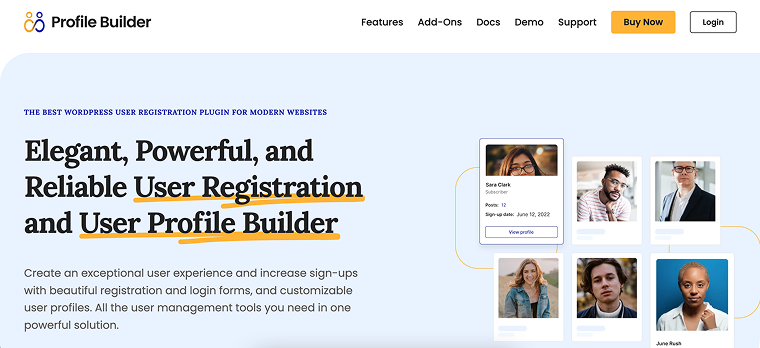
Profile Builder is a highly useful plugin that allows you to customize your login, registration, and user profiles all in one place, without requiring any code modifications. It’s ideal for sites that require more than just a basic login page, such as membership sites or online communities. What I like about it is how it combines login customization with user management features, allowing you to access a wide range of features in a single tool.
Key features:
- easy drag-and-drop builder to create and customize your login, registration, and profile forms;
- set custom redirects after login, logout, or registration to guide users where you want;
- works well with multiple user roles, letting you create different forms or rules for different groups;
- offers spam protection and lets you customize emails;
- plays nicely with WooCommerce and popular membership plugins.
Pricing: there’s a free version that covers the basics, but if you want all the cool features, paid plans start at $99/year for one site.
Pros:
- great if you want more than just login page tweaks, it’s a full user management solution;
- the drag-and-drop form builder makes customizing really simple;
- integrates well with other WordPress plugins you might already use.
Cons:
- the free version is limited – you need the premium to get the full set of features;
- if you only need to customize your login page, it might be more than you actually need.
Nextend Social Login (Free/Premium)
🏆 Best for simplifying user registration and login processes with seamless social media integration.
As mentioned above, using information from popular social networking services to sign in to third-party websites has many advantages. For the users, it offers a hassle-free registration and login method. For the site admins, it brings additional information about users.
Nextend Social Login plugin makes it easy to use the benefits of social login. The text and buttons are editable, and avatars from all major social media platforms are available to make the customization process quick and smooth. It’s highly recommended to try this plugin for an enhanced user experience!
Key features:
- social login integration with various platforms;
- user profile data synchronization;
- ability to display social media profile pictures as avatars.
Pros:
- simple and user-friendly interface;
- functional free version;
- seamless integration with social media accounts.
Cons:
- limited support options for free users.
Custom Login Page Customizer (Free)
🏆 Best for customizing all details of the WordPress login page.
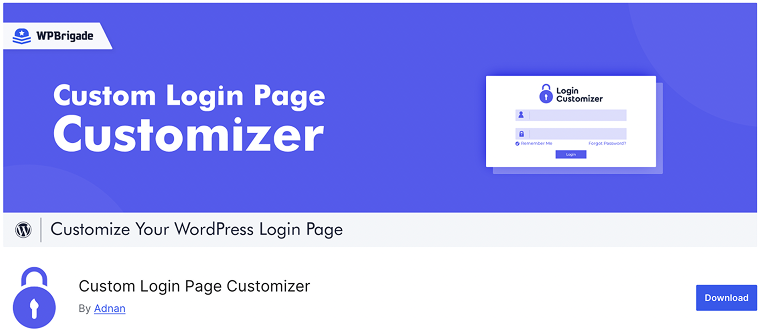
Custom Login Page Customizer is another all-in-one solution. Each of the tools it uses is simple, but using these tools in a bundle gives you a professionally looking page that perfectly fits with the branding. The customization results are shown in real-time, with the possibility of saving the changes during the process. If there’s no time to create a WordPress login page from scratch, choose from various available templates.
Key features:
- simple customization dashboard;
- integrates with WordPress multisite;
- works with custom CSS.
Pricing: free.
Pros:
- provides extensive customization features for logos, fields, and backgrounds;
- a user-friendly interface, both for beginner and advanced developers;
- free.
Cons:
- doesn’t include templates.
Branda (Free)
🏆 Best for matching WordPress login pages with your brand design.
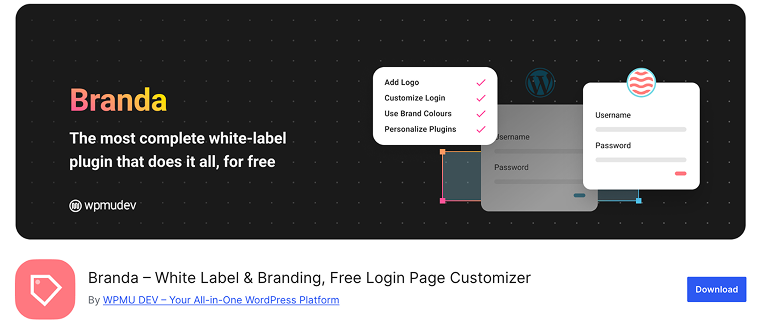
Branda allows you to white label the WordPress front end to the backend, including the login page, without coding. It is helpful if you aim to rebrand the entire site. A very cool feature of the Branda plugin is the ability to create a custom login page template that can later be used on other websites. Naturally, it comes with all the essential features necessary for a login page editor.
Key features:
- adds a footer section with custom text;
- admin CSS customization;
- GDPR compliance tools;
- custom login screens.
Pricing: free.
Pros:
- easy to create templates and use on multiple sites;
- user-friendly interface.
Cons:
- some advanced features may require technical knowledge to implement effectively.
Colorlib Login Customizer (Free)
🏆 Best for customizing login pages while bolstering website security.
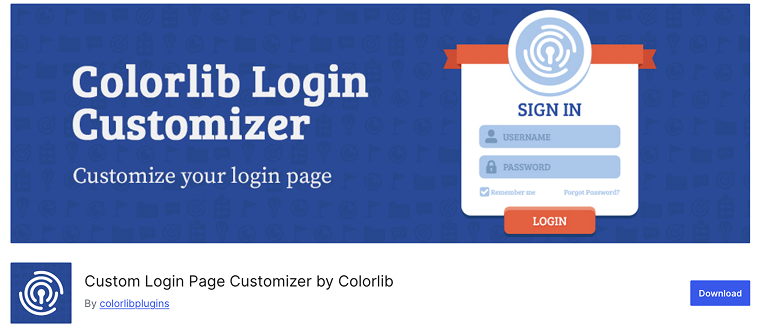
This custom login page plugin is designed to be used by beginners and professional developers. Having even a little experience editing WordPress themes will make it very easy to use this plugin’s user-friendly interface. With this powerful tool, you get complete control of creating a custom logo, background, and login forms for a unique login page. Plugins like this one make an impression that they are an essential part of your website layout.
Key features:
- color scheme presets;
- custom CSS.
Pricing: free.
Pros:
- allows configuring login page through WordPress customizer;
- absolutely free.
Cons:
- doesn’t have some advanced features that the premium plugins offer.
Registration and Login Form Plugins in WordPress
Alternatively, you can choose advanced form plugins that offer login functionality and various other form-related features for users to utilize on the front end.
WPForms (Free/Premium)
🏆 Best for novice WordPress website owners who want to build advanced templates.
WPForms caters to WordPress users of all levels who need to create various types of forms, including login forms, contact forms, surveys, and more, with ease and efficiency. It’s particularly suitable for businesses, bloggers, and website owners looking for a user-friendly form plugin with robust features and integration options. With the help of premade templates, login and user registration forms can be created in a few clicks.
Key features:
- drag-and-drop builder;
- customizable forms dependent on user behavior;
- spam-protection features.
Pricing: free version with limited abilities or premium plans starting at $99 per year.
Pros:
- many pre-made templates;
- user-friendly interface.
Cons:
- only basic options in the free version;
- advanced design customization required coding.
JetFormBuilder (Free/Premium)
🏆 Best for combining login and password reset functions in one solution for membership, eCommerce, and other sites requiring user authorization.
JetFormBuilder is a free, comprehensive tool for creating forms of any complexity using WordPress blocks. Its advanced features include multi-step forms, conditional visibility, and multiple specialized fields for a flawless building process.
While you can build all form types for free, you’d need a paid add-on to implement an email authorization method and select logging in the user as the form post-submit action. As the forms are constructed of WordPress native blocks and integrate with the free JetStyleManager plugin, you’re free to configure every design detail and attach log-in forms to any pages or pop-ups.
Key features:
- password reset functionality;
- “Remember Me” checkbox field;
- possibility to identify registered users;
- verification option;
- integrates with any WordPress editor or theme.
Pricing: the JetFormBuilder plugin is free. The User Login Action add-on is $49 per year. This one and other premium add-ons are also included for free in the Crocoblock All-Inclusive subscription.
Pros:
- no limits on the type of forms you can build; purchase add-ons for certain post-submit actions;
- conditional logic for field visibility and execution of post-submit actions;
- integration with Crocoblock dynamic plugins and numerous third-party solutions.
Cons:
- the free version doesn’t include user registration via email.
How to Create a Custom WordPress Login Page
In addition to basic customization of the default login form, you can create a fully custom login page with unique design, structure, and logic. You’re free to build the login form from scratch, add password reset functionality, custom error messages, checkboxes, post-login redirects, and display the form on any page of your site. With flexible settings and visual controls, the entire login process can be seamlessly integrated into your branded interface, eliminating the need for coding skills.Learn more about creating a custom login and reset password form with JetFormBuilder.
FAQ
Yes. You can do that using custom login page plugins.
Yes. Most of the WordPress login plugins give you that option.
Some of the plugins have both free and premium versions. Others are paid only.
A custom login page improves UX, navigation, site security, and branding.
Choose a customization plugin that has the option to create custom login page templates.
The number, type, and weight of elements used on a page are some of the factors that affect page load time.
Sum Up
Creating a custom login page has several benefits if the site has multiple users who interact with the login page daily. It enhances the overall user experience by applying eye-catching designs, makes this page an integral part of the website, and improves navigation by adding links, social icons, and call-to-action buttons. When creating a site for a client, it is better to change default login features to demonstrate attention to detail and control over all aspects of WordPress developer skills.
To build an eCommerce platform or a membership site with the capability to authorize numerous users, consider utilizing advanced form plugins such as JetFormBuilder and WPForms, which offer user login functionalities.